
Melisa García: "Justice was not designed for us — and that is exactly why we have to transform it"
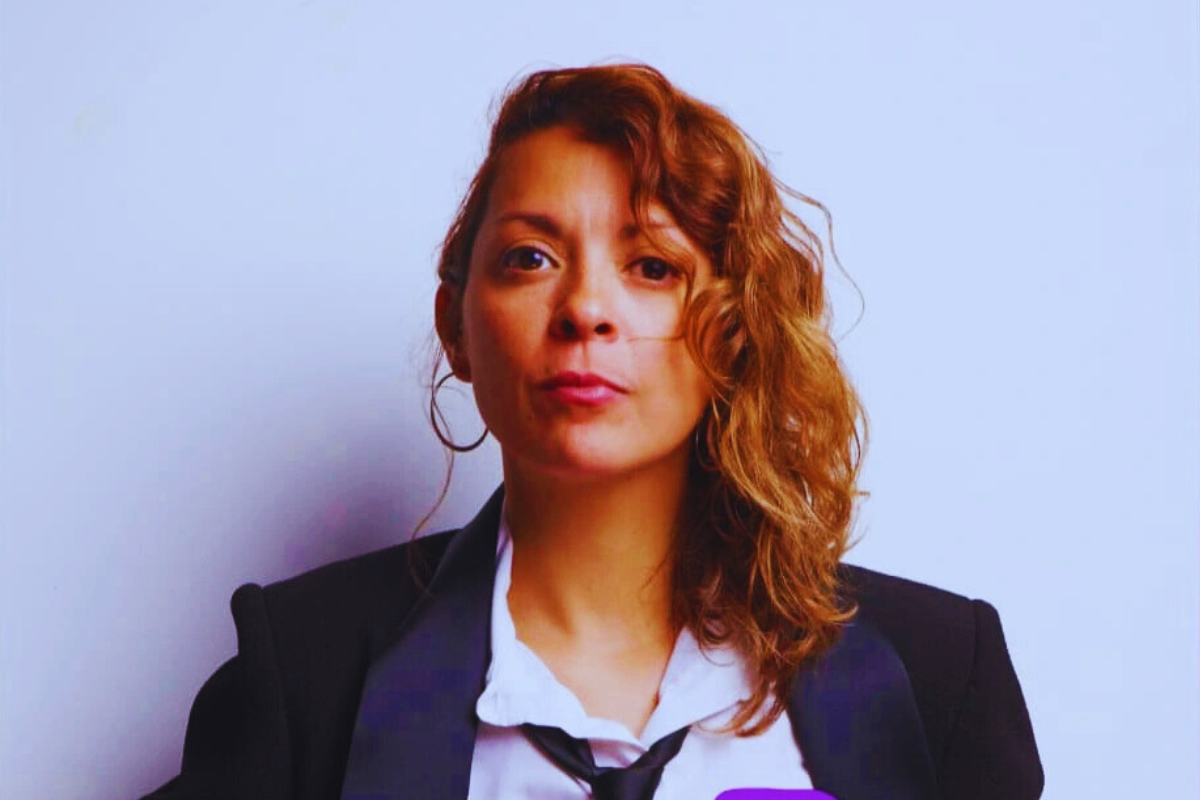
This interview was originally published on May 25, 2025 and updated on March 2, 2026. Estimated reading time: ~8 min
In a context of institutional rollbacks on gender issues, we spoke with one of the most active voices in feminist law in Argentina. Melisa García is a lawyer, academic, and founder of ABOFEM Argentina — an organisation that for seven years has worked to transform legal practice through a gender and human rights lens. It was 2018 and the streets of Buenos Aires were buzzing with the news from Chile, where no young person, it seemed, was without the knowledge of how to organise strategically in the face of a police advance. Among the waves of young migrants stood an enduring gratitude toward Argentina's public university system, which had opened its lecture halls to dozens of students with degrees begun elsewhere. Those voices multiplied the enthusiasm, eventually giving rise to an organisation in this part of the world — where the green tide rose fierce and unbowed.
A law built in community: the birth of ABOFEM Argentina
Melisa García is a lawyer, academic, and founder of an organisation that turned that message from the Chilean streets into concrete action: organise and act. She embraced the idea and decided to transform the everyday bad practices of the legal profession into an ethical, accessible form of lawyering committed to human rights. Her motivation was rooted in the need to build community within professional practice. "I always say that throughout one's professional journey — and especially in actual practice — we are taught to be opposing parties. You get along with a colleague here and there, share a case sometimes, but generally we are on opposite sides of the street." It was 2018, and Argentina was demanding the passage of the Voluntary Termination of Pregnancy law. For many organisations, this represented an opportunity for unity across collectives, NGOs, and groups with shared goals. "That logic of a movement operating from different fronts was also a fundamental part of what drove us forward," Melisa recalls.
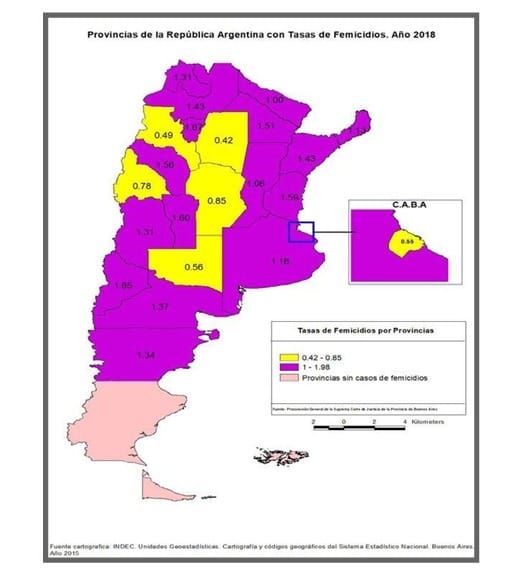
The report on femicides issued by the Argentine Supreme Court for 2018 recorded 278 gender-based killings. According to the work of the now-defunct Women's Office, there were 255 direct femicides and transfemicides, while the remaining 23 fell under the category of "linked femicides." The figure represents a 10.7% increase compared to the 251 crimes of this nature recorded in 2017. Source: Argentine Supreme Court of Justice.
In the middle of that same year, the National Registry of Femicides of the Argentine Judiciary was in the process of implementing and refining a protocol in collaboration with the Women's Office to improve the quality of femicide statistics across different jurisdictions. No one imagined that six years later, with its offices dismantled, the Ministry of Women — conceived as a comprehensive body to structurally transform public policy with a gender focus — would disappear, reduced to the Under-Secretariat for Protection Against Gender Violence, operating as a residual unit, focused on holding threads together without a budget and with zero capacity for institutional influence or impact.
In this context, strategies that strengthen a feminist intervention in law — against a legal system that has historically rendered invisible and delegitimised the claims of women and dissident communities — become vital. And so does their dissemination.
Listening, contextualising, humanising: the keys to feminist lawyering
The lack of active listening at police stations, compounded by the limited empathy and patience of state agents when faced with everyday problems, has led to the creation of spaces for reflection and stillness — using language that, rather than alienating, offers better guidance to those who come seeking help. At the moment of filing a complaint, speaking in clear language and understanding context is a fundamental strategy. "The historical barrier we have encountered is that active listening — even when it is part of the professional role — directly affects how each case is approached. This affects not only the specific person who comes to file a complaint, seek advice, or receive a comprehensive consultation, but it is also reflected in how the problem is framed — even a situation of violence.
The main barrier lies in a system that does not allow — and even less so in the current context — for the kind of contextualisation and historicisation that are so necessary. On the contrary, it tends to close in on already established logics. We cannot forget that law was created by men, from a patriarchal logic. This does not mean that women are not participating today in the construction of law, but rather that its historical foundations are deeply marked by that matrix.
Applying a gender perspective — as required by international standards, including those that Argentina has incorporated — implies a structural transformation. Yet the current government denies, dismantles, and trivialises these tools, framing them as purely ideological. The reality is that they are not: they are frameworks designed to incorporate a human rights perspective — one centred on children, women, and gender — into law and the justice system. When the system stalls or regresses, providing an adequate response becomes even more difficult." For Melisa, it is about challenging justice from a position that names what is missing, what has yet to be guaranteed: "I always say that being a feminist lawyer with a gender perspective means being something of a craftswoman. It is about using what is available in normative, doctrinal, and jurisprudential terms — what is specific to our profession — but also being able to contextualise what is happening in the streets, in activism, in everyday life. I am not only referring to formal access to justice, but to what it means to dignify a person who is looking for a solution, especially when they are in a position of vulnerability. That is where we become craftswomen, and that, for me, is the greatest strategy."
This is what ABOFEM has tried to embody — a meeting point between academia and activism: "one without the other becomes rigid or ineffective, but when they are combined, they become the foundation of feminist lawyering."
A judicial system that refuses to look
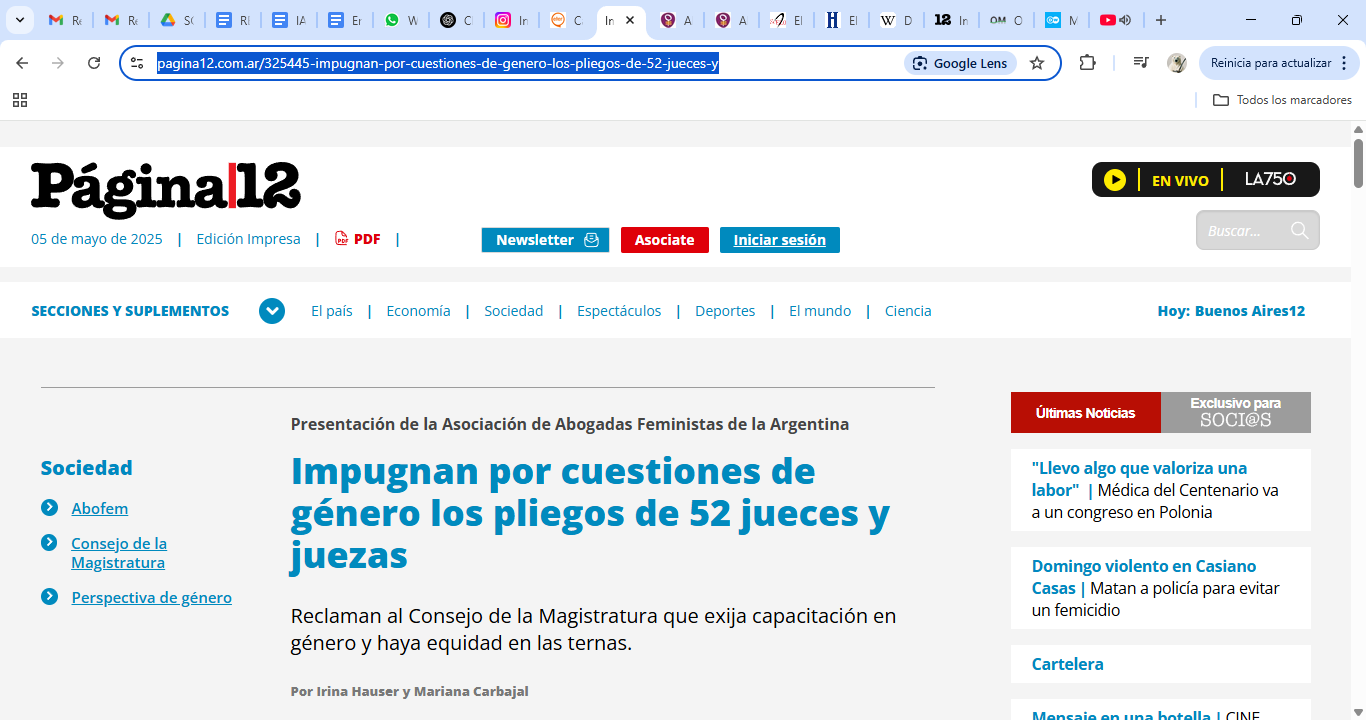
Screenshot of a digital article from Página 12, February 23, 2021
The year 2021 marked a milestone for Melisa and her colleagues at the organisation's helm, when they successfully challenged the nominations of 52 judges on the grounds that the required gender-perspective training for judicial appointments was not being met, and that the candidate shortlists did not comply with gender parity requirements. The news spread like wildfire, as did the reputation of the team, after Mariana Carabajal published in Página 12 the damning list of challenged nominations — with the name of every judge who lacked the required training. "I was in Chivilcoy. I lied to myself, I convinced myself I was taking a few days off (laughs). My phone was exploding. Judges were writing to me — especially female judges — justifying themselves, telling me they did have gender training. They wanted to send me proof of what they had done. One of them even threatened me, saying we would cross paths again," Sandra (co-founder and early partner of ABOFEM) recounted in an interview with the digital outlet Mujeres del Sur.
According to the organisation (ELA) — the Latin American Team for Justice and Gender, gender bias can affect the impartiality of judges, and the absence of a gender perspective in judicial selection can generate inequalities in the application of justice — undermining confidence in the judicial system, a fact that is almost an established constant in Argentina. The intervention of the ABOFEM team was key in putting the issue on the table and prompting action.
Femicides, impunity, and numbers that will not fall
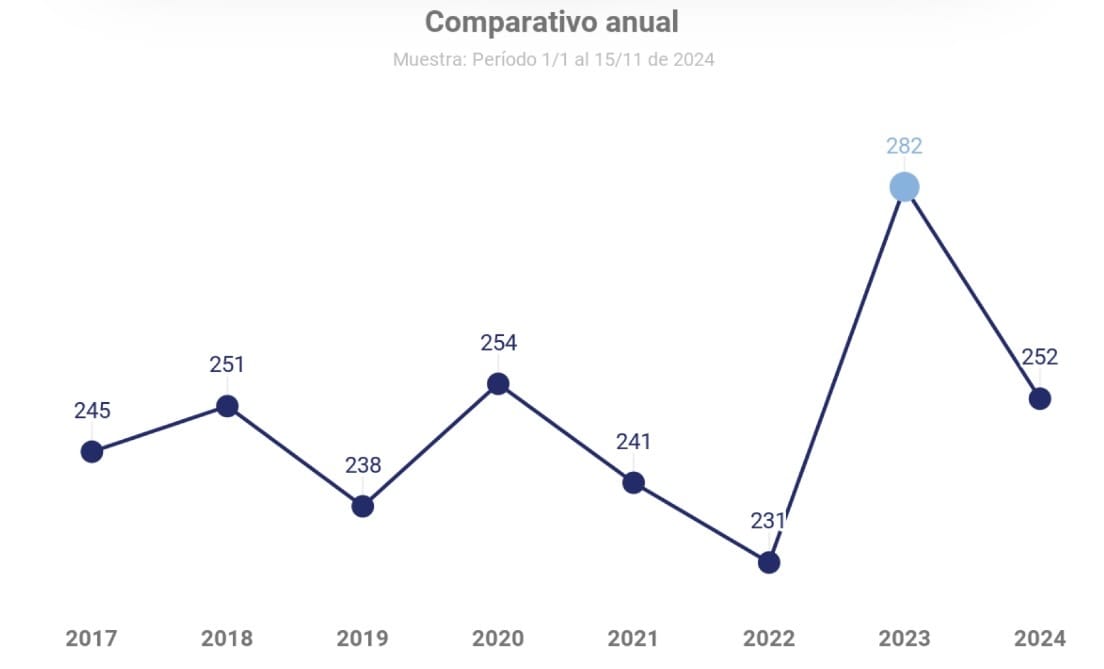
According to data published by the National Ombudsman's Office on November 22, 2024, Argentina recorded 252 femicides in the year to date. Among them: 20 linked femicides, 7 trans victims, 10 femicide-suicides, and 12 violent deaths of women in contexts of drug trafficking and organised crime. With an average of one femicide every 30 hours, this year's figures remain at levels similar to those of 2020 — the pandemic year — demonstrating the persistence of gender-based violence despite public policies implemented. 66% of victims were killed in their own homes, workplaces, or residences shared with the perpetrator. In 84% of cases, a prior relationship existed between victim and perpetrator. Additionally, 169 girls and boys were left orphaned as a result of these crimes. The most common method was stabbing, followed by firearms and strangulation; in 21 cases, women were raped before being killed. Geographically, the provinces with the highest rates of femicide relative to population were Chaco, Santiago del Estero, Misiones, Chubut, and Salta. Source: www.dpn.gob.ar
Civil resistance in the face of a dismantling state
**In November 2024, the Latin American Team for Justice and Gender (ELA) presented a report documenting the systematic hollowing out of policies against gender-based violence. On this, ABOFEM's founder said: "**this report, together with the elimination of the Ministry of Women, Gender Identities and Diversity, is yet another demonstration of what we have been denouncing: the emptying out, the elimination of resources, and the deliberate confusion being manufactured around the purpose of these policies.
Twisting their objectives with budgetary arguments generates an enormous setback. It also confuses many people who are living in situations of violence and who need to understand when they are being violated. It is not simply a matter of going and filing a complaint. There is an internal, subjective, deeply complex process involved in recognising that one is immersed in a situation of violence — and in being able to ask for help.
That requires active promotion by the state, as the law prescribes. Offering the possibility of filing a complaint is not enough — that is almost the final step. That is why the elimination of the Ministry is not merely symbolic. It is an attempt to erase a historical achievement in terms of feminist struggle.
The discussion over why specific spaces need to be created is a recurring one. My view is that they should not be necessary — if everywhere there were genuine respect and effective promotion of these rights. But since there is not, they are indispensable. And so is their visibility.
Today we face a very complex context. It is not only an attack on gender policies — it is an attempt to deny human rights as a whole. This government seeks the absolute reduction of our rights, including through hunger, in order to prevent people from being able to defend themselves.
The only thing I can say is that we are a people with a history of struggle in very difficult contexts. And we have always taken to the streets to defend our rights. Today it falls to us to resist — and so we will."