Analogue and digital: Chomsky on AI
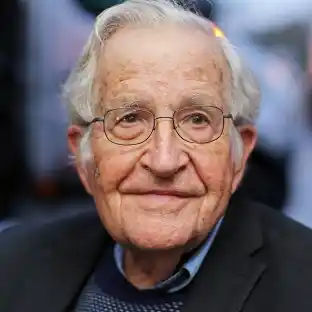
Always eloquent and reflective, at 94 years of age linguist, philosopher, and political scientist Noam Chomsky agreed to an interview with a YouTuber (@edukitchen) and shared his views on the new artificial intelligence ChatGPT and its use in education.
Estimated reading time: 3–6 minutes
Let's talk about ChatGPT and its use in the education system.
Well, GPT is a system that accesses a large amount of data to generate content based on the premise it is given. It can be used to write book reports and other assignments, but it is essentially a form of high-tech plagiarism that degrades education. While there have been plagiarism detection programmes in the past, GPT makes it even more challenging by making plagiarised work harder to identify. However, these systems do not truly understand language or cognition, and they tell us nothing about these areas. The better these systems become, the greater their failures will be, because they are equally effective with real language and invented language. In essence, they are like the periodic table, but one that includes both real and invented elements — and those have no value for science or its understanding. While GPT may have some utility, it is not clear what that is.
You were a university professor — how would you deal with this kind of problem, with students using GPT to write reports or complete their assignments?
I spent most of my life at MIT. This would simply not have happened there, because the students would not even have thought of doing it. They were interested in what they were studying, and they put in the effort. No student learns anything by using this software — nothing. It is simply a way of avoiding learning. There are places where education is made more interesting so that students learn of their own volition — that is one approach. In other places, at other universities, professors ban iPhones, yet students sit there chatting on their iPhones anyway. The real challenge is to make classes genuinely interesting so that everyone wants to learn and no one would think of avoiding them.
Do you think companies like Neuralink will be able to connect our brains to computers and programme parts of the brain so that we no longer need to learn languages like French?
I am not very concerned about that, as it is mostly science fiction. Far too little is known about the brain — even the idea of detecting neural signals to perform actions like raising a hand remains a challenge. As for learning French, I would not worry about that. We already have the technology to access linguistic resources through computers. For example, I am currently using a laptop, and with a couple of keystrokes I can easily find out what something written in French says.
Right — Google Translate is fast enough for a simultaneous conversation with a French speaker; you do not need to know the language.
I use Google Translate, but you cannot always trust what you see. It is a way for us to know whether an article is worth reading. You get a basic idea of what it is about, and if you are genuinely interested in understanding it, you would never rely on Google Translate or ChatGPT.
ChatGPT, if you want to get a sense of what it is — it is basically nothing. I mean, I have nothing against things that are useful. Right now, for example, I am using live transcription. It is the same thing in its most extreme form, but it is useful. I do not fully trust it — you will see a lot of errors — but it is far better. It is an excellent aid for people with hearing difficulties, so it serves its purpose. It is a visual aid, like glasses for someone with a vision impairment.
So Neuralink is not a threat to education at the moment, nor an improvement — at least for now. If you had to predict what education will look like thirty years from now, what would you tell us?
It depends on educators, curriculum planning, government officials, and those who fund — and above all, those who do not fund — education. It is all of them who determine whether education is engaging for students, whether it responds to their needs and questions. And there will always be many ways to avoid it.
Let me share my own experience: when I went to university in 1945, we had to take a chemistry course. It was a basic course and so boring that I could not stand it. I never went to class — a friend took very precise notes and we both passed. I never went to the laboratory either. I had the manual, and it was obvious how the experiments would turn out. So I filled in the lab manual, and the professors found out when I enrolled for the second term. I was reprimanded for breakages in the laboratory, and I could not say anything. I did not even know where the laboratory was. That is the worst way to educate.
To come back to the question: what is the future of education? Of course, I took courses on things I was genuinely interested in — I paid attention, worked very hard, tried to learn what I was being taught. That is the education worth cultivating: those interests and questions. If that work fails, students will do what I did in the chemistry course — but with ChatGPT.
Translation by Nadia Schneider